
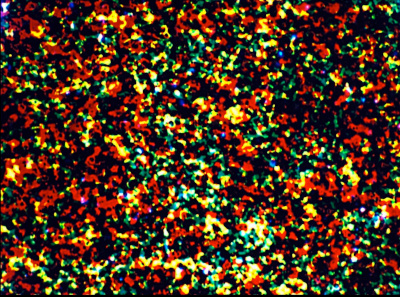
2017, Netherlands, 16mm handmade emulsion loops printed to color, sound by Ji Youn Kang, 12 min.
Do your view of an image change when you know something horrific or disturbing took place in it? Even though you may not see (or recognize) anything? Is this “not seeing” essential to boost the imagination?
For Deletion I visited six locations in the Netherlands which in the (recent) past have caused a lot of commotion because they were the scene of disturbing and/or horrific crimes that have had considerable impact on society. On these locations I have shot black & white footage whereby I did not picture the landscape itself but where I took extreme close-ups of the “guilty” spots that are somehow reminiscent of a human shape or form. A swaying leaf, a bit of fabric fluttering in the wind, a torn plastic bag in the water.
The inspiration for Deletion is the Autochrome process, a method lost in time used to create color from black & white footage. A coloring technique for black & white photos from the pioneering phase of photo- and cinematography. Invented by the Lumière brothers in 1903, minuscule granules of potato starch stained red-orange, blue-violet and green created the illusion of an image in color. This potato starch generated color by placing a granulated pattern of the three main colors (RGB) in front of a black & white image.
For Deletion I attempted to create an enlargement of this technique. It’s as if you look at the image through a microscope: rustling granules in which contours become apparent. Using this technique I materialized “apparitions” that are only partially recognizable and which appear to be the residue of a human form. An image intended to evoke the same sensation as the primal instinct that makes us watch disasters and horrific scenes. The resulting image/film is quite abstract. As a spectator you are given the opportunity to use your own imagination and see what you want to see.
The ambient soundtrack arose from a collaboration with Ji Youn Kang, a Korean sound artist living in the Netherlands. He holds a master of Sonology 2nd phase from the Royal Conservatory with Paul Berg and has a preference for electro-acoustic music and music composition. The soundtrack is freely inspired by the intro from The Texas Chain Saw Massacre (1974).